In industrial settings, various types of vacuum pumps are used depending on the specific application and requirements. Here are some common types:
Positive Displacement Pumps:
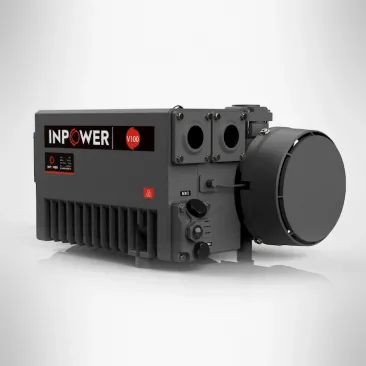
Rotary Vane Pumps: These pumps use a rotor with sliding vanes to create a vacuum. They are commonly used in applications requiring medium to low vacuum.
Diaphragm Pumps: They use a diaphragm that moves back and forth to create a vacuum. They are suitable for applications requiring chemical resistance and high purity.
Piston Pumps: These pumps use a piston moving within a cylinder to create a vacuum. They are often used in high-vacuum applications.
Dynamic Pumps:
Centrifugal Pumps: These pumps use high-speed impellers to move gas and create a vacuum. They are typically used for applications that require a high flow rate but lower vacuum levels.
Roots Blowers (or Roots Pumps): These pumps use two counter-rotating lobes to move gas. They are often used in conjunction with other pumps to achieve high vacuum levels.
Entrapment Pumps:
Cryopumps: These pumps use extremely low temperatures to condense and trap gases. They are used in ultra-high vacuum applications.
Sorbtion Pumps: These pumps use materials that adsorb gases to create a vacuum. They are used in high and ultra-high vacuum systems.
Molecular Pumps:
Turbomolecular Pumps: These pumps use a high-speed rotating turbine to direct gas molecules towards the exhaust. They are ideal for creating high and ultra-high vacuums.
Diffusion Pumps:
These pumps use a high-speed jet of vapor to move gas molecules towards the pump's exhaust. They are commonly used in ultra-high vacuum applications.
Steam Ejector Pumps:
These pumps use steam to create a vacuum by entraining the gas being pumped. They are used in applications where a high flow rate and low vacuum are needed.
Each type of vacuum pump has its advantages and is selected based on factors like the level of vacuum required, the type of gases involved, and the specific application needs.