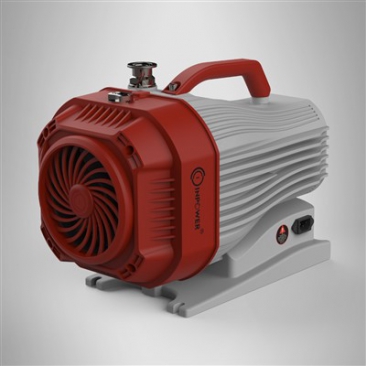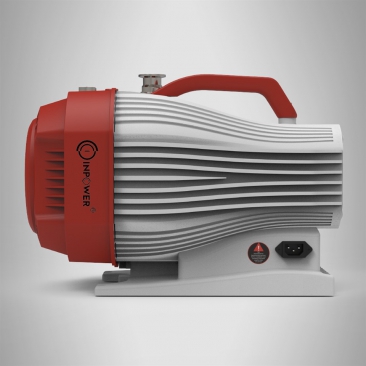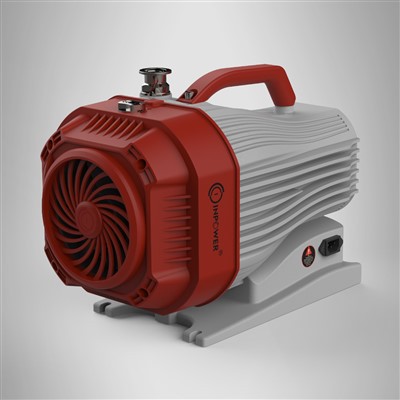
InPowerVac low pressure vacuum 10 ^ -7 mbar turbo are capable of reaching ultra-high vacuum levels by using a combination of high-speed rotating blades and molecular drag to remove gas molecules from the chamber.
Model:G10/16/36/45
Ultimate vacuum: ≤1Pa
SPEED 50 Hz:10-45 m³/h
SPEED 60 Hz: 10-45 m³/h
inPowerVac low pressure vacuum 10 ^ -7 mbar turbo Technical parameters:
|
MODEL |
G10 |
G30 |
|
|
Nominal Rotation Speed |
rpm |
1800 |
1750 |
|
Displacement |
m³/h |
12 |
30 |
|
Ultimate Vacuum |
mbar |
0.01 |
0.008 |
|
Motor Power |
W |
400 |
750 |
|
Voltage Input |
V |
1- phase 100-240 |
1- phase100-240 / 3- phase200-460 |
|
Noise Level |
dB |
54 |
63 |
|
Inlet Flange |
- |
KF25 |
KF40 |
|
Exhaust Flange |
- |
KF25 |
KF40 |
|
Max Water Vapour Pumping Rate |
g/h |
100 |
60 |
|
Cooling System |
- |
Air-cooled |
Air-cooled |
|
Weight |
kg |
28 |
44 |
|
Dimensions |
mm |
430×255×290 |
490*305*400 |
characteristic:
(1)High pumping speed: Turbo pumps can achieve high pumping speeds, usually in the range of hundreds to thousands of liters per second, which enables them to rapidly evacuate gas molecules from the chamber, resulting in a low pressure environment.
(2)Ultra-high vacuum (UHV) capability: With a pressure of 10^-7 mbar, the system is capable of reaching ultra-high vacuum levels, which are essential for many sensitive applications requiring minimal gas interference.
(3)Low vibration and noise: Turbo pumps are designed to operate with minimal vibration and noise, which is crucial for applications where precision and stability are required, such as in electron microscopy or semiconductor fabrication.
(4)Compatibility with other vacuum components: The vacuum system components, including the turbo pump, should be compatible with each other to ensure efficient operation and minimal contamination or leaks.
(5)Reliability and durability: Turbo pumps are engineered for long-term reliability and durability, often with features such as magnetic bearings or lubrication systems to minimize wear and maintenance requirements.
low pressure vacuum 10 ^ -7 mbar turbo Applications:
(1)Surface Science: Research in surface science, such as scanning tunneling microscopy (STM), atomic force microscopy (AFM), and X-ray photoelectron spectroscopy (XPS), often requires ultra-high vacuum conditions to study surface properties and interactions at the atomic level.
(2)Thin Film Deposition: Processes like physical vapor deposition (PVD) and chemical vapor deposition (CVD) for thin film deposition in semiconductor manufacturing, optics, and other industries benefit from low-pressure environments to ensure high-quality film growth and material properties.
(3)Mass Spectrometry: High-resolution mass spectrometers used in analytical chemistry and biochemistry require ultra-high vacuum conditions to facilitate the ionization, separation, and detection of molecules with high sensitivity and accuracy.
(4)Particle Accelerators: Ultra-high vacuum systems are essential components in particle accelerators and beamlines to minimize gas collisions and maintain beam quality during particle experiments and research.
(5)Space Simulation: Vacuum chambers with ultra-high vacuum levels are utilized for space simulation tests, including spacecraft component testing, satellite thermal balance testing, and astronaut training in simulated space environments.
(6)Fusion Research: Experimental fusion reactors and plasma devices require ultra-high vacuum conditions to create and maintain the high-temperature, high-density plasma needed for controlled nuclear fusion reactions.
(7)High-End Electron Microscopy: Transmission electron microscopes (TEM) and scanning electron microscopes (SEM) operating under ultra-high vacuum conditions provide high-resolution imaging and analysis of materials for scientific research and materials characterization.
(8)Synchrotron Radiation Facilities: Synchrotron radiation facilities use ultra-high vacuum systems in beamlines and experimental stations to enable advanced research in materials science, biology, and physics using synchrotron light sources.